The Broadside of a Yarn: A Situationist Strategy for Spinning Sea Stories Ashore

Categories:  conference, electronic literature, exhibition, launch, performance, Writing Coastlines
Tags: , , , , , , , , , , ,

Announcing The Broadside of a Yarn, a new hybrid print-digital-performance-writing work by J. R. Carpenter, commissioned by ELMCIP for Remediating the Social, launching at Inspace in Edinburgh 1 November 2012.

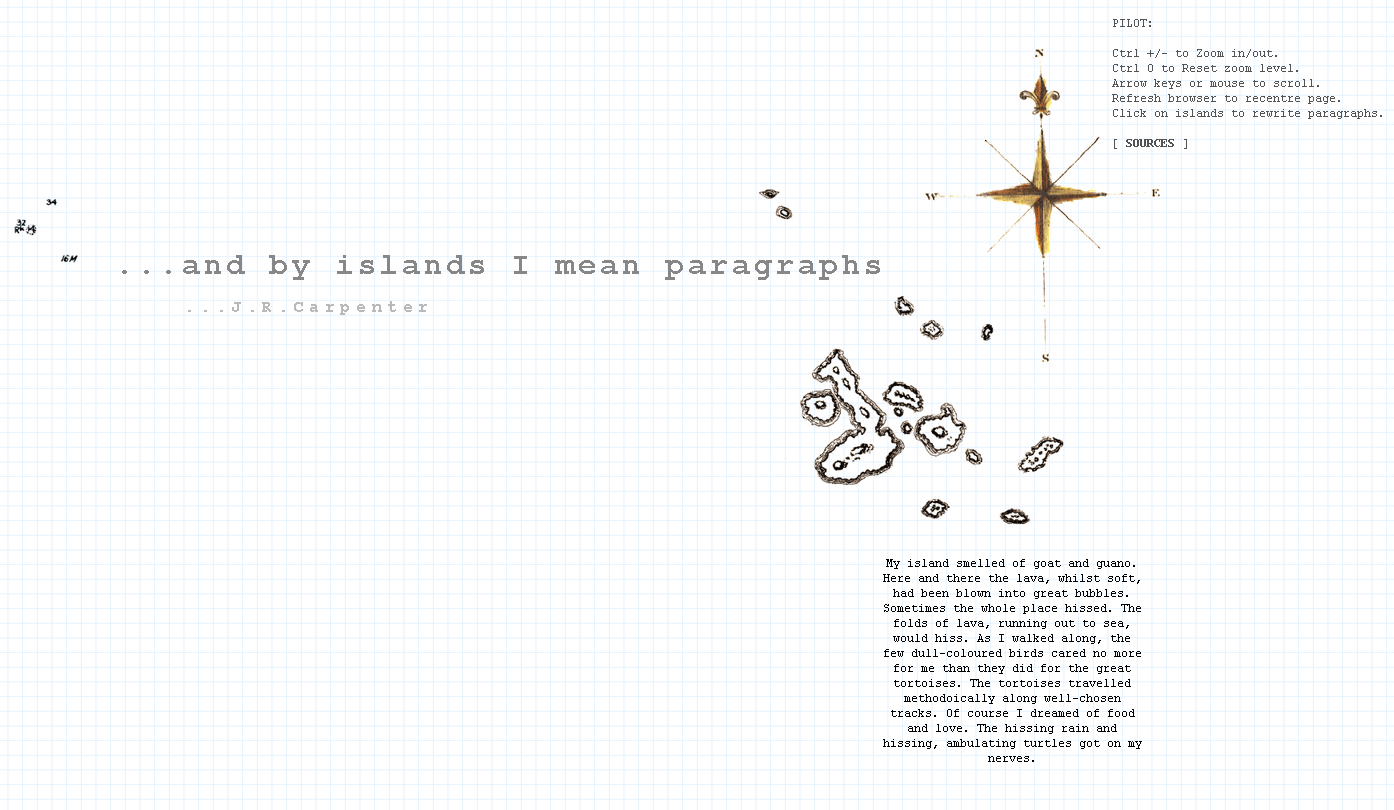
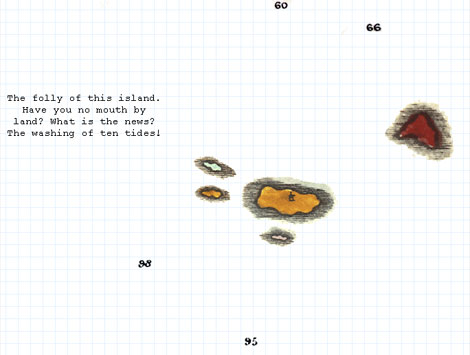
In theory, The Broadside of a Yarn is a multi-modal performative pervasive networked narrative attempt to chart fictional fragments of new and long-ago stories of near and far-away seas with naught but a QR code reader and an unbound atlas of hand-made maps of dubious accuracy. In practice, this project is, in a Situationist sense, a willfully absurd endeavour. How can I, a displaced native of rural Nova Scotia (New Scotland), perform the navigation of a narrative route through urban Edinburgh (Old Scotland)? How can any inhabitant of dry land possibly understand the constantly shifting perspective of stories of the high seas?

The Broadside of a Yarn

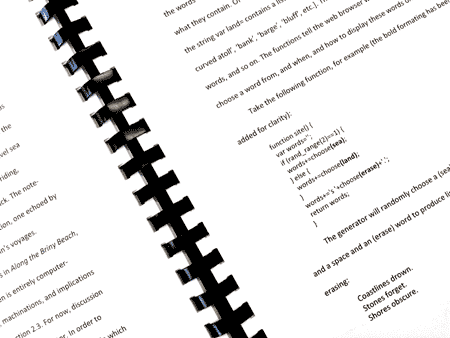
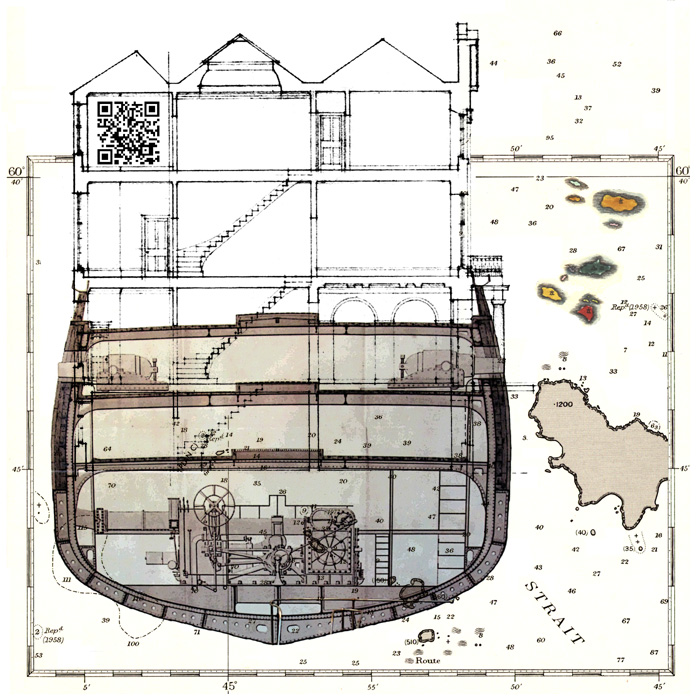
The Broadside of a Yarn remediates the broadside, a form of networked narrative popular from 16th century onward. Broadsides were written on a wide range of topical subjects, cheaply printed on single sheets of paper (often with images), widely distributed, and posted and performed in public. During the Remediating the Social exhibition (Inspace, Edinburgh, 1-25 November 2012), The Broadside of a Yarn will be posted as a grid of A3-sized square maps, and freely distributed as broadside-sized sheet (while supplies last).

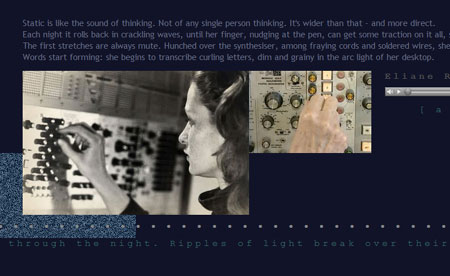
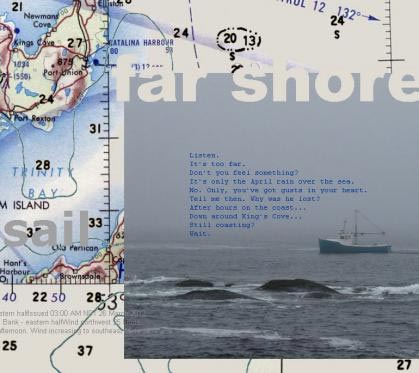
Like the printed broadside ballads of old, the public posting of The Broadside of a Yarn signifies that it is intended to be performed. Embedded within the highly visual cartographic space of this printed map are QR codes which link mobile devices to a collection of separate yet interrelated web pages containing computer-generated narrative dialogues. They may propose imprecise and possibly impossible walking routes through the city. Or they may serve as scripts for poli-vocal performances.

The Broadside of a Yarn

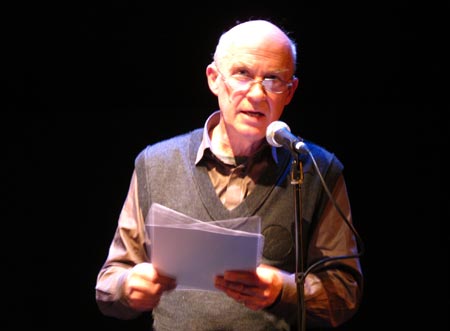
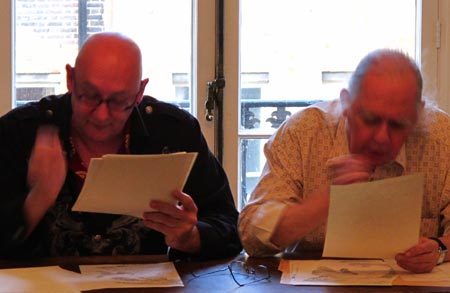
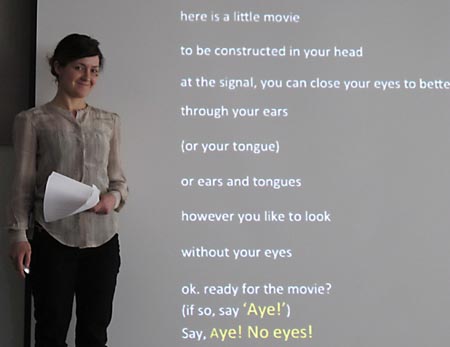
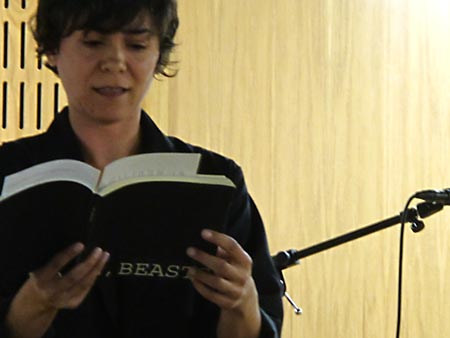
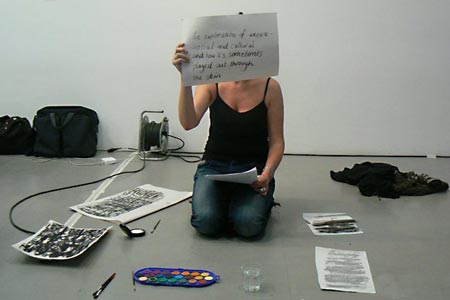
The Broadside of a Yarn will be performed in four or possibly five voices (microphone availability depending) Thursday 1st November 20.00 in the Sculpture Court of Edinburgh College of Art. For more information, please see the Remediating the Social program.

A comprehensive overview of the Remediating the Social conference and exhibition has bee posted on Electronic Literature Authoring Software by Judy Malloy: ELMCIP Invites Scholars and Artists to Remediating the Social, Edinburgh, November 1-3, 2012

For more information – including a bibliography of the wide range of maps and literary works cited in The Broadside of a Yarn – and to view more images of the print maps to be installed at Inspace, please visit Luckysoap.com.

There he was, gone.

Categories:  electronic literature, publication
Tags: , , , , , ,

Presenting: There he was, gone. A new computer-generated narrative dialogue published on Joyland Poetry. Many thanks to Joyland Poetry’s Europe editor angela rawlings, who solicited and encouraged this work, to Jerome Fletcher and Barbara Bridger, who provided much useful feedback during the creation process, and to all those who have lent their voices to poli-vocal performances of this work.

There he was, gone. has been performed by Barbara Bridger, David Prater, Christine Wilks and myself at Arnolfini, Bristol, UK during PW12 Performance Writing Weekend, in association with ELMCIP Seminar on Digital Textuality with/in Performance, 3-6 May 2012; and by Debra di Blasi, Jerome Fletcher, Judd Morrissey and myself at the Sorbonne, Paris, during &Now 2012: New Writing in Paris: Exchanges and Cross-Fertilizations, 6-10 June 2012.

There he was, gone.

How do we piece together a story like this one? A mystery. The title offers more questions than answers. There he was, gone. Where is there? Who is he? Where has he gone? How is this sentence even possible? There he was, not there. As if “he” is in two places and in no place, both at once. The once of “once upon a time.” This story has to do with time. This story has to do with place. That much is clear. We time to look around the story space. What do we see? A corner of a map. An abstraction of a place too detailed to place, unless the places it names are already familiar. Is this a local story then? For locals, between locals… if we do not know the answer to this question, then we are not local. We seem to have stumbled upon an ongoing conversation. Listen. A dialogue of sorts. It’s too late. An argument, even. One interlocutor instigates. Can’t you feel anything? The other obfuscates. It’s only the spring squalls over the bay. All that’s not said between these two hangs in a heavy mist, a sea fret low over a small fishing boat turned broadside to a pack of hump-backed slick black rocks. This story is fishing inshore. Close to home. Tell me then. Where was he found? A litany of place names follows. No answers. More questions. Wait. Listen. This story keeps shifting. Slow scrolling lines of poem roll in. set sail on home sick ship shape house wreck. What help is that to anyone? We arrive and we have only just finished leaving. What use is a poem? We sift through the fine print, searching for clues. GALE WARNING IN EFFECT, Funk Island Bank. Weather conditions for today’s date. Wind northwest 25 knots diminishing to west 15 this morning and to light this afternoon. Is the disappearance hinted at in the title a recent one? There he was, gone. Whoever he was, wherever he went, this story springs from his absence. J. R. Carpenter 2012

View There he was, gone.

Performing Digital Texts in European Contexts : A New Commentary Column on Jacket2

Categories:  electronic literature, web art, writing
Tags: , ,

Jacket2 Last night I started a new sustained writing project. For the next three months I will be a regular commentator for Jacket2, an online journal of modern and contemporary poetry and poetics associated with PennSound and the Kelly Writers House at the University of Pennsylvania in Philadelphia, Pennsylvania, USA.

I will be posting under the still somewhat tentative header, Performing Digital Text in European Contexts. In this space I will endeavour to collect, recollect and comment on a wide variety of digital texts and contexts operating in the inter-zones where digital media, literature, visual art and performance practices meet. My first post further outlines the kinds of texts and contexts I’m thinking of. Although, or rather because, I already have certain writers, works, venues, events and organizations in mind, I actively seek suggestions on others. If you or someone you know is performing digital texts in European contexts, please let me know through the contact information on the Jacket2 page.

Other recent Jacket2 commentators have included Oana Avasilichioaei, writing on experimental Canadian poetics in Folding Borders: Experimenting in the Canadian Laboratory, Eric Baus, writing on lesser known gems from the PennSound archive in Notes on PennSound, and Charles Bernstein, writing on, you know, the myriad and many things Charles Bernstein. Needless to say, I’m thrilled to join this company.

More information about Jacket2.

Performing Digital Text in European Contexts

Along the Briny Beach

Categories:  electronic literature, festival, Generation(s), performance, poetry, publication
Tags: , , , , , , , ,

My most recent piece of digital poetry, Along the Briny Beach, generates a coastline. The source code loads the following variables: Land Sea Write Erase Walk Liminal Space. The variable _Read_ is assumed to be client-side. The function _Writing and Erasing_ returns: Edges Ledges and Legible Lines caught in the Double-Bind of Writing and Erasing. Onload: Write Coast.

Along the Briny Beach appears in the new garden-theme issue of Boulder Pavement, an elegant multi-media journal published by The Banff Centre Press three times a year.

Along the briny beach a garden grows. With silver bells and cockleshells, cockles and mussels, alive, alive oh. A coral orchard puts forth raucous pink blossoms. A bouquet of sea anemones tosses in the shallows. A crop of cliffs hedges a sand-sown lawn mown twice daily by long green-thumbed waves rowing in rolling rows. The shifting terrain where land and water meet is always neither land nor water and is always both. The sea garden’s paths are fraught with comings and goings. Sea birds in ones and twos. Scissor-beak, Kingfisher, Parrot, and Scissor-tail. Changes in the Zoology. Causes of Extinction. From the ship the sea garden seems to glisten and drip with steam. Along a blue sea whose glitter is blurred by a creeping mist, the Walrus and the Carpenter are walking close at hand. A pleasant walk, a pleasant talk along the briny storied waiting in-between space. Wind blooms in the marram dunes. The tide far out, the ocean shrunken. On the bluff a shingled beach house sprouts, the colour of artichoke. On the horizon lines of tankers hang, like Chinese lanterns. Ocean currents collect crazy lawn ornaments. Shoes and shipwrecks, cabbages and kings. Water bottle caps and thick white snarls of string. At dawn an ancient tractor crawls along the briny beach, harvesting the tide’s leaves. The world’s plastic, the sea’s weeds.

Along the Briny Beach was performed in collaboration with Jerome Fletcher at E-Poetry [ 2011 ] : International Digital Language | Media | Arts Festival at SUNY Buffalo, Buffalo, NY, May 19, 2011.

The source code for the poetry generating component of Along the Briny Beach is based on Taroko Gorge, by Nick Montfort, other remixes of which appear in my recent book GENERATION[S].

Along the Briny Beach || Boulder Pavement 4

Whisper Wire: A Poetry Generator Transmitting and Receiving Electronic Voice Phenomena Through Haunted Media

Categories:  conference, electronic literature, Generation(s), performance
Tags: , , , , , , , ,

Whisper Wire is a new poetry generator by J.R. Carpenter, a text transmitter, a code medium sending and receiving a steady stream of strange sounds, disembodied voices, ghost whispers, distant wails and other intercepted attempts to communicate over vast distances through copper wires, telegraph cables, transistor radios and other haunted media.

From the outset, telegraphy has been associated with otherworldly presences. If intelligence and consciousness could be transmitted independent of the body, surely the dead could speak to the living though electromagnetic means. This perception persisted nearly a century, even as telegraph and telephone networks girdled the globe with cables, signals, switches and stations.

null

December 14, 1901, three short sharp clicks skipped this grid. The Morse letter S travelled from Poldu, Cornwall — not troubled at at by the curvature of the Earth or the salt wet and wind of the Atlantic — to Saint-John’s, Newfoundland, where it was received by a telephonic headset held to the highly sensitive receiver of Guglielmo Marconi’s waiting ear.

Was the Morse letter S appended to Saint-John’s that day? Hoax rumours abound. Some suggest that what Marconi heard was actually a harmonic — a connection, yes, but not a transmission. Distance distorts. Distance distends. We hear what we need to. Wireless technology revealed a vast, unfathomable ocean of silence and static. Deep listening into that void can return uncanny results. Whisper Wire generates an unheimlich poem of un-homed messages, a spectrum of strange and unexplainable sounds, hunting the either for a listener, a receiver, a media to haunt.

The source code of Whisper Wire is itself possessed. Whisper Wire is a remix of Nick Montfort’s Taroko Gorge. Excerpts and source code of another of J.R. Carpenter’s remixes of Taroko Gorge, titled simply GORGE, appear in her new hybrid code narrative book GENERATION[S], published by TRAUMAWIEN.

Whisper Wire will be performed in Edinburgh on Halloween night at Inspace… no one can hear you scream, an evening of language in digital performance presented by the third International Conference on Interactive Digital Storytelling and New Media Scotland.

Whisper Wire will become a live wire during this 20 minute hybrid performance. Performance writers J.R. Carpenter and Jerome Fletcher will mix generated text, javascript, found sounds and live readings from the works of decadent authors, Medlar Lucan & Durian Gray and others.

“As we stand on the clifftop at Poldhu, watching the wind which roars in off the Atlantic whipping spindrift off the tops of the waves, we are filled with an overwhelming sense of horror. Between here and New York nothing but grotesque tonnages of uncooked haddock swim. Nowhere is Nature present in such profusion, and we have chosen to expose ourselves to it for the next three days!

At this spot a century ago, Guglielmo Marconi set up a circle of masts by which he would transmit the first radio signals beyond the curve of the earth. We too are here to communicate. Not with the Living, however, but with the Dead.”

Medlar Lucan & Durian Gray with Paul Renner, The Hell Fire Touring Club, Oxford: Pharsalia, 2004, page 21.

48 hours | Inspace… no one can hear you scream.
Sunday 31st October 2010, 7.30 for 8pm.
Inspace, 1 Crichton Street, Edinburgh EH8 9AB

Inspace

Inspace… no one can hear you scream: an evening of language in digital performance

Categories:  conference, electronic literature, Generation(s), performance
Tags: , , , , ,

Sunday 31st October 2010, 7.30 pm, the third International Conference on Interactive Digital Storytelling and New Media Scotland will present an evening of language in digital performance with works by Martin John Callanan, J.R. Carpenter, Jerome Fletcher, Donna Leishman, Maria Mencia, Netwurker Mez, Stanza and Christine Wilks. The performance event will be held on Halloween. There will be a haunted theme.

48 hours | Inspace… no one can hear you scream.

Sunday 31st October 2010, 7.30 for 8pm.

Inspace, 1 Crichton Street, Edinburgh EH8 9AB

ICIDS Conference Program

Inspace

JRC PhD

Categories:  Writing Coastlines
Tags: , , , , , , ,

I’m going back to school this week, for the first time in a very long time. I’m excited. What took me so long? I graduated with a BFA in Studio Art from Concordia University in Montreal in 1995, the year Netscape came out. Remember Netscape? No? Well it was a really big deal at the time. It changed my life, anyway. I have been using the internet as a medium for the creation and dissemination of non-linear inter-textual hyper-media narratives ever since.

I never got around to doing a masters degree, mostly because I could never figure out what on earth to do one in. It seemed silly to go get another degree in the same subject I just got a degree in. But the more work I did in areas I had never studied the less qualified I seemed to be to pursue those subjects academically. Yes, Creative Writing MA, I’m talking to you. Categories confuse me, as do departments and disciplines. Some of my best friends are academics. Not that there’s anything wrong with that. I just never met the write, I mean right M(F)A for me. Besides, I’ve been busy. The past fifteen years have been full of thinking and making and teaching and showing and writing and trying all kinds of things in all kinds of forms and forums, by writing into them, learning from them and watching them shift and change.

Things have changed muchly lately. For one thing, the non-linear inter-textual hyper-media narrative thing I’ve been slogging away at for so long is now an actual real thing. The electronic literature community has been incredibly good to me. And much of the electronic literature community’s activity is academically based. Increasingly, the opportunities, communities and collaborations I engage in are aided and abetted by academic institutions in some way. I’m cool with that. I like research. I like conferences. I especially like going to conferences and meeting fascinating people who have research labs in fascinating places which then sometimes invite me to and if I can go I get to meet even more neat new people and all the while I’m hearing about new work and talking about my work and selling everybody zines. No really, sometimes it really happens that way.

In May 2009 I went to an E-Poetry conference in Barcelona and met someone from the Performance Writing area at Dartington College of Art in the UK. Within a few months I was teaching an electronic literature workshop in the Performance Writing area at Dartington and thinking: Wow, electronic literature basically IS Performance Writing. And damn, if I had heard of the MA in Performance Writing at Dartington I would have done it years ago. But I am really glad I didn’t. Because now Dartington College of Art has merged with University College Falmouth in Cornwall, and I have been awarded a studentship to do a three-year practice-led PhD research degree at University College Falmouth in partnership with University of the Arts London. I will live in South West England, where it hardly ever snows, travel here and there, use the heck out of the nation’s libraries, meet lots of new people, try and sell them all zines and keep on doing the thinking, making, teaching, showing, writing and trying all kinds of things that I’ve been doing all along, only with funding, structure and support.

Now seems a fine time to go back to school.

Darting Stories Remix

Categories:  electronic literature
Tags: , , , , , , , , , , , ,

As E-Writer-in-Residence at Dartington College, in Devon, England, this fall, I led a workshop on electronic literature with a concentration on literary mapping with first year Performance Writing Students. Over the course of the workshop students generated short texts for zines, postcards, epitaphs, blog posts and web maps. Though written separately, these texts explored common themes of place, mapping, the River Dart, Dartington and the past occupants (fictional or otherwise) of Dartington Hall. The workshop exercises and the texts they produced are archived on a group blog: Darting Blog. These texts are presented collectively as a final project on a Google Map: DARTING: A Collective Story Map

The last session of the workshop focused on remixing. I created a Darting Stories Remix by taking sentences from the various (and varied) texts archived on the Darting Blog and fed them into one of Nick Montfort’s Python story generators. I had used this same method earlier in the year to create Excerpts from the Chronicles of Pookie and JR.

For the purposes of this Darting Stories Remix, I shortened some of the sentences or selected excerpts from longer sentences to fit into the Python story generator format, and changed them all into the present tense and first person. Otherwise, these remain sentences written separately by separate authors remixed by a Python script to make collectively authored stories.

To read the Darting Stories Remix, download this file to your desktop and unzip: Darting.py On a Mac or Linux system, you can run the story generator by opening a Terminal Window, typing “cd Desktop”, and typing “python Darting.py”. Hint: look for Terminal in your Utilities folder. This Python story generator runs on Windows, too, but you will probably need to install Python first: version 2.6. Once Python is installed you can double click on the file and it will automatically launch and run in the terminal window. Every time you press Return a new version of the story will appear. For example:

Here are a few more examples of stories generated by this script:

Darting Stories:
How do I write an epitaph about myself in the first person?.
Through the depths of the water I reflect far and wide.
Hadrian’s Wall might have mostly come down, but it’s there in spirit.
Mad, that’s what they call me.
I crave little more than my freedom, my air, and my land.
I will walk directionless, till the unknown end.
Striving to connect with something natural.
To be continued…

Darting Stories:
At the start, I look for the lights.
What do names matter when worlds whirl together?.
I don’t live in a house, where they could watch me.
I live along the Dart but not around the towns where they patrol.
I pass out in the dirt-floored cellar most nights.
Sunlight barely reaches the stone floor.
I am a fervent keeper of horses, ponies and barns.
Websta’s brother died in the Dart. Had his throat slit.
The sea is a place I understand is rather nice.
Introvert, extravert, ingreen.
This the most achingly beautiful place to come across a little death.
To be continued…

Darting Stories:
Stories run off the Moor with it’s river waters.
I stride up hill holding hands with a friend named for the greatest flower.
William, sweet or otherwise, has never been my name.
I scare their dogs by trying to speak with them in their own language.
Graceless truths of tears clutch at the mirage in my room.
The ponies look more listless and less majestic.
It gets so muddy here; no wonder all the cows around here are brown.
The wind gives the landscape something of a facial peel.
Splash water into mud, trip me.
Smouldering timber and melancholy permeate my lungs. I stick to the path.
This the most achingly beautiful place to come across a little death.
To be continued…

Darting Stories:
On this hill the world as we know it collided.
Intoxicating tongues speak of Giants, Merlins, Padfoots and Beasts.
Geoffrey of Monmouth’s accounts are unfounded, possibly fabricated.
The clay on the wheel beneath my fingers, whirling a world on its axis.
William, sweet or otherwise, has never been my name.
I crave little more than my freedom, my air, and my land.
I don’t live in a house, where they could watch me.
I live along the Dart but not around the towns where they patrol.
I will walk directionless, till the unknown end.
I am a fervent keeper of horses, ponies and barns.
To be continued…

Darting Stories:
Stories run off the Moor with it’s river waters.
I will walk directionless, till the unknown end.
Fear and bliss live with me and the room contains me.
Websta’s brother died in the Dart. Had his throat slit.
Black looms in the distance, the air thick with distaste.
The Waters of the Dart run across stones fallen from foreign clouds.
Map the most important places around the River Dart.
Exmoor, outmore, out the door, more doors.
More floor, less flaws, less cause, pour, pore, sweat, regret.
Skip over Kandinsky pavement, follow the water.
Flotsam on a tidal river is a strange mixture of oak leaves and seaweed.
To be continued…
. . . . .

DARTING: A Collective Story Map

Categories:  electronic literature, workshop
Tags: , , , , , , , ,

Over a period of five weeks a collective of writers of the River Dart worked collaboratively on a web-based writing project about the River Dart and the history – fictional or otherwise – of Dartington Hall. A series of short texts were written separately, for zines, postcards and blog posts. These texts were then collected, found texts and images were added, and all were collated onto this Google Map:

http://maps.google.com/maps/ms?ie=UTF8&t=h&msa=0&msid=109811778856642161490.00046c5ac479d9ec8655d&ll=50.443513,-3.841095&spn=0.538733,1.454315&z=10


For more information on how the writers of the River Dart came to collectively create DARTING: A Collective Story Map, visit their blog: http://dartingmap.blogspot.com/
. . . . .

E-Writer in Residence, Dartington Campus, UCF

Categories:  electronic literature, reading
Tags: , , , , , , , ,

This fall I am the Performance Writing E-Writer in Residence at University College Falmouth’s Dartington Campus, located on the Dartington Hall Estate, a 1,200 acre mixture of arable and pastoral farmland, woodland, residential and commercial accommodation. Written records of this site do not begin until the thirteenth century, but there is evidence of considerable activity in the area during the Roman occupation and the manor of Dartington is mentioned in a Royal Charter of 833 AD. The buildings and structures situated on the estate range in age from Deer Park Wall and Earth Works at North Wood which date from the Bronze and Iron Ages, to the main Hall which was built in 1388, to those properties which were built by the Elmhirsts in the 1930s, 1940s and 1950s. The site has been continuously occupied for well over a thousand years, but this is the last year that Performance Writing will be located here, so I feel most fortunate to be here at this time.

My duties at E-Writer in Residence mostly involve sitting in my office, working on my work. The above photo is not a view from my office, thankfully, or I’d be too busy staring out the window to get any work done. One of my favourite things about the campus is how, to get from one side of it to the other, you have to walk across part of a cow pasture with actual cow pats in it (not pictured). I do this sometimes just to go to the library to visit the copy of my novel that they have there. I’m also leading an electronic literature workshop with the Performance Writing undergraduates, with a concentration on literary mapping. And I’ll do a public reading on the Dartington Campus Thursday 3 December, 7.30pm in Studio 3 (free). This will be the last in a series of three performances dedicated to readings featuring innovative and dynamic writers. For more information on this event, visit The Arts at Dartington.
. . . . .