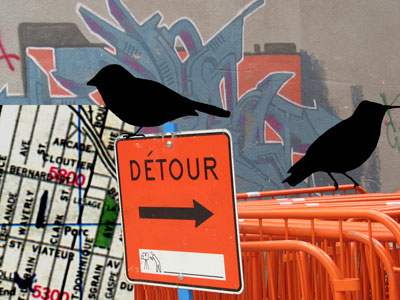
in absentia – a new web project by J. R. Carpenter

Categories:  electronic literature, in absentia
Tags: , , , , , , , , , ,

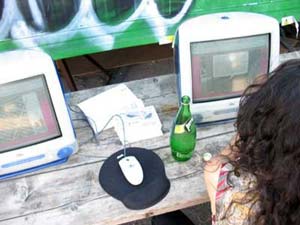
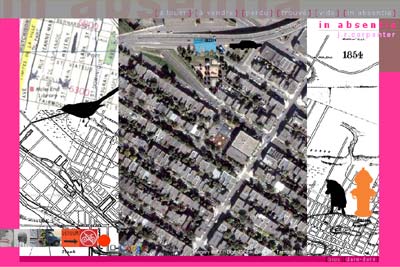
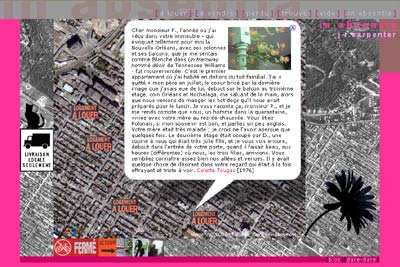
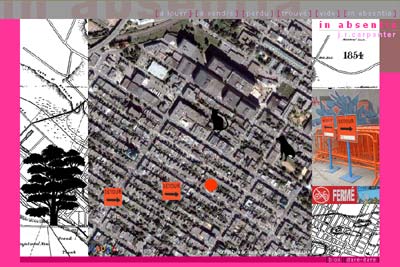
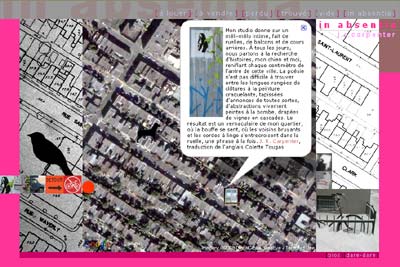
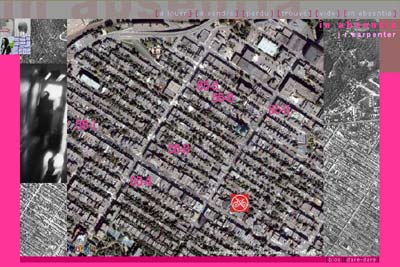
in absentia is a new web-based writing project by J. R. Carpenter that addresses gentrification and its erasures in the Mile End neighbourhood of Montreal. In this work J. R. Carpenter uses HTML, javascript and the Google Maps API to create an interactive non-linear narrative of interconnected “postcard” stories written from the point of view of former tenants of Mile End forced out by gentrification. This project features new fiction by J. R. Carpenter with guest authors: Lance Blomgren, Andy Brown, Daniel Canty and Colette Tougas. New stories will continue to be be added throughout the summer and into the all of 2008. http://luckysoap.com/inabsentia

in absentia is a Latin phrase meaning “in absence.” I’m drawn to the contradiction inherent in being in absence. In recent years many long-time low-income neighbours being forced out of Mile End by economically motivated decisions made their absence. So far fiction is the best way I’ve found to give voice these disappeared neighbours, and the web is the best place I’ve found to situate their stories. Our stories. My building is for sale; my family may be next. Faced with imminent eviction I’ve begun to write about the Mile End as if I’m no longer here, and to write about a Mile End that is no longer here. By manipulating the Google Maps API, I am able to populate “real” satellite images of my neighbourhood with “fictional” characters and events. I aim to both literally and figuratively map the sudden disappearances of characters, fictional or otherwise, from the places, real or imagined, where they once lived; to document traces people leave behind when they leave a place, and the stories that spring from their absence. in absentia is a web “site” haunted by the stories of former residents of Mile End, a slightly fantastical world that is already lost but at the same time is still fully known by its inhabitants: a shared memory of the neighbourhood as it never really was but could have been.

Themes of place and displacement pervade my fiction and electronic literature, yet place long remained an abstract, elusive notion for me. Perhaps because for many years I wrote about long ago places attempting to inhabit pasts that could never be mine. Mapping the minutia of my most immediate surroundings has made my notion of place less abstract and more socially engaged. Writing about my neighbours has made me aware that I write from amongst them, thus engendering a “we” point of view. Increasingly, my work is collaborative. In in absentia (June 2008) I join a cast of writers from my neighbourhood to pen “postcards” to and from former tenants, fictional or otherwise, displaced by gentrification and it’s erasures.

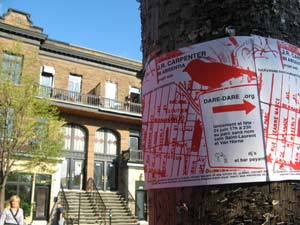
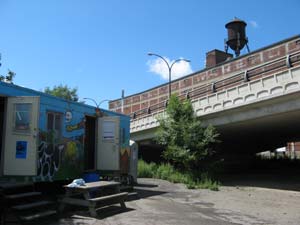
in absentia also marks the end of DARE-DARE’s Dis/location: projet d’articulation urbaine in the Mile End’s parc sans nom. The mobile office will leave the vacant lot that was its home for two years and move towards Montréal’s dowtown, in Cabot Square, corner Sainte-Catherine and Atwater. http://dare-dare.org

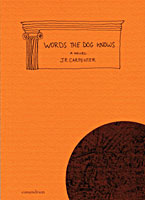
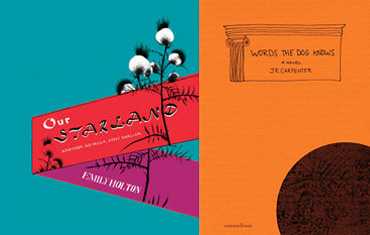
J. R. Carpenter is a two-time winner of the CBC Quebec Short Story Competition and a Web Art Finalist in the Drunken Boat PanLiterary Awards 2006. Her novel Words the Dog Knows is forthcoming from Conundrum in the fall of 2008. Her short fiction and electronic literature have been published and exhibited internationally and can be found on http://luckysoap.com.

in absentia projet web de J.R. Carpenter inauguré le 24 juin au parc sans nom
DARE-DARE avec nouvelles oeuvres de fiction signées J. R. Carpenter, avec auteurs invités: Lance Blomgren, Andy Brown, Daniel Canty, Alexis O’Hara et Colette Tougas La réalisation du projet se poursuivra jusqu’au 30 novembre 2008. http://luckysoap.com/inabsentia

in absentia est un projet d’écriture sur le Web qui traite de la gentrification dans le quartier Mile-End de Montréal et des disparitions qu’elle entraîne. J.R. Carpenter utilise le HTML, le JavaScript et les cartes API-Google pour créer une narration interactive non linéaire constituée d’histoires « cartes postales » écrites selon le point de vue d’anciens locataires du Mile-End forcés de quitter leur logement à cause de la gentrification. Le projet débutera le 24 juin et se poursuivra au cours de l’été et de l’automne 2008.

« L’expression latine in absentia signifie “en l’absence de”. Au cours des dernières années, plusieurs de mes voisins à faible revenu qui habitaient le Mile-End depuis longtemps ont été forcés de quitter le quartier en raison de décisions d’ordre économique prises en leur absence. À ce jour, la fiction s’avère le meilleur moyen pour raconter l’histoire de mes voisins disparus et le Web, le meilleur endroit où afficher leur histoire. Notre histoire. L’immeuble que j’habite est à vendre; ma famille et moi subirons peut-être le même sort prochainement. Menacée d’expulsion, j’ai commencé à écrire sur le Mile-End comme si je n’y étais plus et à écrire sur le Mile-End qui n’est plus. En manipulant les cartes API-Google, il m’est possible de peupler de personnages fictifs les “vraies” images satellites de mon quartier et d’inventer des situations. Je cartographie – au sens propre et figuré – la disparition soudaine de personnages fictifs ou non, des endroits où ils ont habité véritablement ou dans l’imaginaire. Je documente les traces que les gens laissent derrière eux lorsqu’ils quittent un endroit ainsi que l’histoire qui émerge de leur absence. in abstentia est un “site” Web hanté par les histoires d’anciens résidants du Mile- End, un univers quasi-fantastique déjà disparu, mais pourtant bien connu de ses habitants: la mémoire commune d’un quartier tel qu’il n’a jamais vraiment été, mais qui aurait pu être. »

« Mes oeuvres de fiction et de littérature électronique baignent dans les thèmes du lieu et du déplacement et pourtant, le lieu est longtemps demeuré un concept abstrait et imprécis à mes yeux. Peut-être parce que j’ai longtemps écrit au sujet de lieux qui n’existaient plus, tentant de m’inscrire dans des passés qui ne pouvaient pas être les miens. »

« Cartographier les menus détails de mon univers immédiat a fait en sorte que je conçois la notion de lieu de façon moins abstraite et avec un plus grand engagement social. En écrivant sur mes voisins, je me suis rendu compte que je me situais parmi eux pour écrire et que, par conséquent, j’adoptais une écriture au “nous”. Je travaille de plus en plus en collaboration. Pour in absentia, je me joins à une équipe d’auteurs de mon quartier pour écrire des “cartes postales” destinées à ou provenant d’anciens locataires, qu’ils soient fictifs ou non, déplacés par la gentrification et les disparitions qu’elle entraîne. »

in absentia marque également la fin du présent volet de Dis/location: projet d’articulation urbaine – ainsi que de la présence de DARE-DARE dans le parc sans nom du Mile-End. La roulotte quittera le site inoccupé où elle était établie depuis deux ans, en route pour le square Cabot au centre-ville de Montréal, à l’angle de Ste-Catherine et Atwater. http://dare-dare.org

J. R. Carpenter est deux fois lauréate du Concours de nouvelles de CBC Quebec et finaliste au volet Web Art pour le prix Drunken Boat PanLiterary 2006. Son roman Words the Dog Knows paraîtra à l’automne 2008 aux éditions Conundrum. Ses oeuvres de fiction et de littérature électronique ont été publiées et présentées ici et à l’étranger et sont disponibles en ligne au http://luckysoap.com.
. . . . .

in absentia launch party June 24th

Categories:  electronic literature, in absentia, launch
Tags: , , , , , , , , ,

Join us for the launch of in absentia – a new web writing project by J.R. Carpenter with guest authors: Lance Blomgren, Andy Brown, Daniel Canty and Colette Tougas. in absentia is presented by DARE-DARE Centre de diffusion dart multidisciplinaire de Montral.

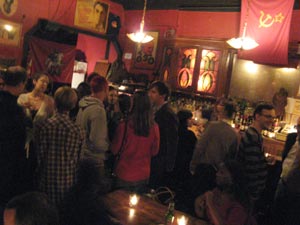
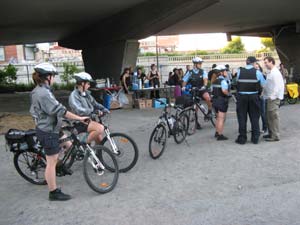
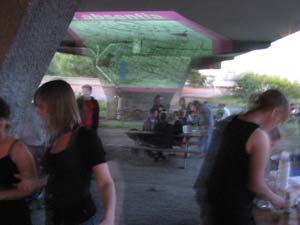
DARE-DARE will host an in absentia launch party on Saint-Jean Baptiste Day, June 24th from 5 – 11PM in the parc sans nom (St. Laurent @ Van Horn). The event is free and open to everyone. There will be DJs and a cash bar and possibly a laser light show, if I have time!

The launch of in absentia marks the end of DARE-DARE’s Dis/location: projet d’articulation urbaine. On July 1st, DARE-DARE’s blue trailer will leave the vacant lot that was its home for two years and move towards Montréal’s downtown, in Cabot Square, corner Sainte-Catherine and Atwater. The launch of in absentia will be the last event held in the Mile End’s parc sans nom, so please come and make it a great one.

in absentia is a web-based writing project that addresses issues of gentrification and its erasures in the Mile End neighbourhood of Montreal. In recent years many long-time low-income neighbours being forced out of Mile End by gentrification. So far fiction is the best way I’ve found to give voice these disappeared neighbours, and the web is the best place I’ve found to situate their stories. Our stories. My building is for sale; my family may be next. Faced with imminent eviction I’ve begun to write as if I’m no longer here, about a Mile End that is no longer here. By manipulating the Google Maps API, I am able to populate “real” satellite images of my neighbourhood with “fictional” characters and events. in absentia is a web “site” haunted by the stories of former residents of Mile End, a slightly fantastical world, a shared memory of the neighbourhood as it never really was but as it could have been. The project will launch in Montreal and on-line on June 24, and new stories will continue to be added until November 30, 2008.

DARE-DARE Centre de diffusion d’art multidisciplinaire de Montréal est situé dans un parc sans nom entre Saint-Laurent et Clark, entre Arcade et Rosemont/Van Horne, Montréal. For more information please visit: dare-dare.og
. . . . .

Tributaries: Behind the Scenes at the Vancouver Launch Event

Categories:  electronic literature, performance, Tributaries and Text-Fed Streams
Tags: , , , , , , ,

Over the course of the six months that I was posting to Tributaries & Text-Fed Streams I had the occasion to explain the project many times to many people, often with little or no success. Some said: Wow, that sounds so cool… But I know they’d never read a word of it. Others smiled and nodded even as their eyes literally glazed over. Only a brave few admitted they had no idea what I was talking about. You few, you are true friends.

None of this bothered me of course. I knew that this exploration of the formal, functional and poetic properties of RSS would be best understood in its natural element (online) and would be most closely read by an online community already habituated to navigating the tributaries of text-fed streams.

So why, from day one, did I insist that the commissioning body, The Capilano Review, go to the trouble and expense to fly me from Montreal to Vancouver for a real-time one-time only launch event?

The more open-ended, circuitous and recursive a project sets out to be, the more necessary closure becomes. I posted the last fragment of text from the “original” source two days before the Vancouver launch. Had not had a plane to catch and a mic to get in front of I could have continued frigging around with the texts of TCR 2-50 indefinitely.

Tributaries curator Kate Armstrong supported the idea of a Vancouver launch event from day one. While she was researching potential launch event venues she sent me this email:

HI JR
Do you by any wild chance know Billy Mavreas?

BILLY MAVREAS is a Greek-Canadian artist and cartoonist living in Montreal. His artwork has been shown internationally. He is the author of The Overlords of Glee (2001) and the upcoming Inside Out Overlap (Timeless Books, 2008), and also the proprietor of his enduring project, Monastiraki, a Mile-End magickal curiosity shoppe and art gallery.

I replied:

> Yeah, he’s my neighbour and dear friend and we were at Banff together
> and so on. Why do you ask? He’s having a show at Helen Pitt around
> the same time I’ll be in Vancouver.

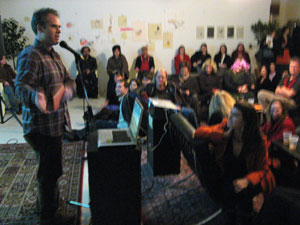
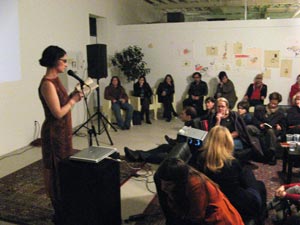
The rest, as they say, took a few more weeks to plan. But in the end, yes, we had the launch event at the Helen Pitt Gallery, where my friend and Montreal neighbour Billy Mavreas was artist in residence and the director Lance Blomgren had just agreed to contribute texts to another electronic literature project I’m working on and all three of us are Conundrum Press authors. Thank you Lance and Billy for letting us take over the Helen Pitt for the evening. Special thanks Billy for physically remixing a print copy of TCR 2-50 and handing out the mini-zine results on the spot, and for making such Tributaries-looking wall art for us to all stand in front of. And extra special thanks Emilie for pouring wine all evening and without whom I might not have made it to the gallery at all that day, but that’s another story.

Many dear friends showed up for the event, including some long-lost ones and some never before met in person ones and some in the “I have no idea what this project’s about” category. The pressure was on!
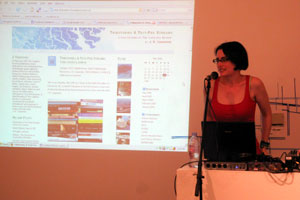
The Tributaries & Text-Fed Streams project is nowhere near as complicated as it sounds. It’s about reading. I held up my copy of TCR 2-50 for the audience to see all the underlined passages, circled sections, arrows, stars and annotations scribbled in the margins. We all do this when we read, don’t we? We interpret, interrupt, form metal images, take notes, and make associations. As I parsed and posted fragments of the essays of TCR 2-50 I marked them up, into JRML, as Kate Armstrong once quipped.

There are hundreds of different ways to read Tributaries & Text-Fed Streams. One good place to start is with the post: What the Heck is RSS?

A good example of JRML is section of Sandra Seekins’ essay dealing with the metaphors and media of biotechnologies which led to me to quote a sequence of pre-genetic-technology references made in literature and philosophy to “metaphors” of bodies as “composites of replaceable parts” in this excerpt: Metaphors of Biotechnology

An intertextual dialogue between TCR 2-50 authors emerges in the matrix/chora section of Kevin Magee’s poem To Write as Speach.

After showing these ways of reading Tributaries I went behind the scenes to show how the piece actually works. I posted an image to Flickr, commented on it, tagged it and then it appeared on the Tributaries main page through the magic of a Flickr RSS feed. I saved a bookmark to del.icio.us and that too was pulled into the Tributaries interface. I posted a new post to Tributaries: Alternate Readings: The In This Issue Remix, then logged into Facebook as Babble Brook (a character created to aid and abet with the Tributaries project). RSS had already pulled the afore mentioned Flickr image, del.icio.us bookmark and Tributaries post into Babble Brook’s profile and pushed news of them out into the feeds of all her friends. Having fed all that info into the text-fed stream, Babble Brook and I got off the mic and let the experts take over.

In a stroke of pure genius Tributaries curator Kate Armstrong invited three experts on streams to perform at the launch event: Dr. Michael Boyce, expert in stream of consciousness; Dr. Maria Lantin, Director of the Intersections Digital Studios, a research space at Emily Carr and thus an expert in data flow; and Dr. Jeremy Venditti, an expert in river geomorphology, turbulence and sediment transport dynamics in gravel-bedded streams. Now Dr. Boyce I’ve known for fifteen years, but Dr. Lantin and Dr. Venditti I’d never met before. This triumvirate of stream experts gave a brilliantly intermingled reading that riffed on the theme of streams. For example, if anyone is still wondering why on earth one would feed the texts of a print journal into a RSS stream, consider the transformational effects of the stream as outlined in this passage quoted by Dr. Venditti:

The Stream – Along the bottom of every gorge is a stream channel. In it may flow a great river or a brook or only a temporary torrent. The stream is there because the slopes of the land guide the water that way, and the stream may thus be said to exist on account of the channel. But in an equally important way the gorge exists because of the stream, for the stream is in fact the maker of the gorge and is still at work on it, deepening and enlarging. Let us look at the stream…
Grove Karl Gilbert and Albert Perry Brigham, An Introduction to Pyhsical Geography, 1902.
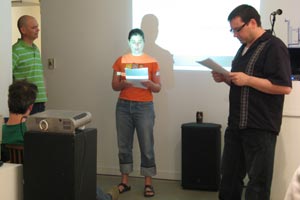
For me – standing in the audience having only just emerged seconds before from six intense months of working on Tributaries & Text-Fed Streams – this intertextual interdisciplinary reading of the work was a gift, and a joy to witness. Thank-you Michael, Maria and Jeremy for your generosity and thank-you Kate from coming up with this idea.

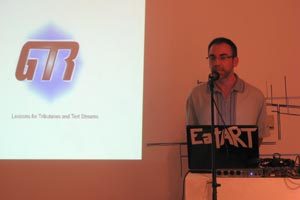
Meanwhile, on the other side of the gallery, throughout the evening TCR 2-50 guest editor and contributor Andrew Klobucar had been feeding portions of the readings into the Global Telelanguage Resources Workbench, which is basically a definition-generating machine. Despite having marked up an essay about this tool in Tributaries, it wasn’t until Andrew read performed the definitions generated in response to the evening’s other performances that I understood how innately hilarious the Global Telelanguage Resources project is! Thank you Andrew!
The performances were followed by a set from DJ Leigh Christie, who had already rocked my world earlier in the day during the tech set up. Even when the internet connection conked out, even when the data projector insisted on projecting upside-down, DJ Leigh kept our spirits running high. Thank you Leigh!
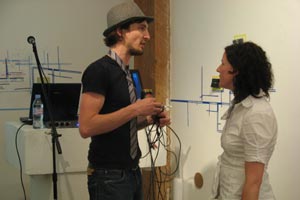
The longer you work on a project the more likely a launch event is to feel anti-climatic, especially an entirely web-based project. In this case, this was not the case. I’m grateful to The Capilano Review for seeing the project through to this conclusion. I was blown away by the turn out for the event, by the emotions of reuniting with long lost friends, by the generosity of all of the contributors and performers and by the responses to the work that the event generated.

Here’s how I know the event was a success: all the people who had told me beforehand that they didn’t get what this work was about came up to me after and said that now they get it. That’s about as climatic as you can get.
. . . . .

Tributaries & Text fed Streams: Launch Event

Categories:  electronic literature, launch, reading, Tributaries and Text-Fed Streams
Tags: , , , , , , , ,

If you happen to be in Vancouver on Saturday May 24th at 7:30PM, come on down to the Helen Pitt Gallery for the launch of Tributaries & Text fed Streams. I’ve been working on this project for just over six months now and am thrilled to see it nearing completion. I’m also thrilled to be heading to Vancouver for this launch. I have so many dear friends in that fair city yet have spent next to no time there. Looking forward to seeing you all – you know who you are!

Tributaries & Text-Fed Streams is commissioned by The Capilano Review and curated by Kate Armstrong. The work explores the poetic, formal and functional properties of RSS using the text of an issue of literary quarterly The Capilano Review as raw material raw the creation of a new artwork. Since January I have reading and re-reading the essays, parsing them into fragments, annotating them, marking them up, tagging them and posting them. Once fed into an RSS stream, the fragments are re-read, reordered, and reblogged in an iterative process of distribution that opens up new readings of the essays and reveals new interrelationships between them.

At the launch event I will read from the piece and perform a guided tour of the various streams feeding into and flowing out of it. In addition, curator Kate Armstrong has put together a programme of experimental readings by practitioners in disparate fields such as quantum physics, geography, and poetics, arranged to explore ideas of streams, seriality, or flow. Participants in the launch event will include Maria Lantin, Michael Boyce, Jeremy Venditti, Global Telelanguage Resources, and me, J.R. Carpenter.

The work will be simultaneously launched on Turbulence.org.

Launch Event:
Saturday, May 24th, 2008 at 7:30pm
Helen Pitt Gallery, 102-148 Alexander Street, Vancouver, BC.

A reception will follow.

For those of you who can’t make it in person, here are some URLS:

Tributaries & Text- Fed Streams: http://tributaries.thecapilanoreview.ca/
The Capilano Review: http://www.thecapilanoreview.ca/
TCR Issue 2-50 : “Artifice and Intelligence”: http://www.thecapilanoreview.ca/archive.php?id=series2/2_50
J.R. Carpenter: http://luckysoap.com/
Turbulence: http://www.turbulence.org
. . . . .

WOMEN’S ART: TAKING OVER THE WEB

Categories:  launch, publication, reading, web art
Tags: , , , , , , ,

Studio XX launches MATRICULES: Canada’s largest public online archive of digital artwork by women and one of the world’s largest online archives of women’s digital art. Created with invaluable support from Heritage Canada’s Canadian Culture Online Program and hosted by Studio XX, Mobile Media Lab and the Department of Communication Studies at Concordia University, Matricules will launch on Tuesday, May 13th, 2008 from 5:30 PM to 7:30 PM at Hexagram Concordia, 1515 Ste-Catherine West (corner Guy) on the 11th floor.

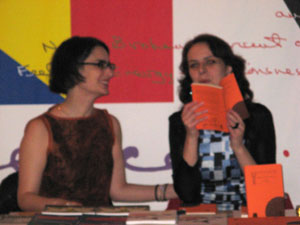
Matricules is an electronic documentary herstory spanning eleven years of research, creation and exploration at Canada’s one-of-a kind Studio XX. Mingle with some of Montreal’s most celebrated new media artists on a spectacular terrace overlooking Montreal and enjoy a performative reading by J.R. Carpenter, two-time winner of CBC’s Quebec Short Story Competition. Prominent interdisciplinary artists Caroline Martel and jake moore will offer their take on the website’s creation process and Matricules Project Director Stephanie Lagueux will give audiences a private tour of this remarkable new digital archive.

The xxxboîte, a limited edition artifact comprised of original texts and a DVD produced in celebration of Studio XX’s first decade will also be presented and available for purchase as an important addition to any contemporary art collection.

Founded in 1996 with the goal of ensuring a defining presence for women in cyberspace and in the development of the digital arts, Studio XX is Canada’s foremost feminist digital art centre for technological exploration, creation and critique. Committed to establishing women’s access to technology, with a strong focus on Open-Source software, Studio XX offers artist residencies, monthly performance salons, an electronic magazine, a weekly radio show and HTMlles: an international biennial cyberarts festival.

“Matricules is a privileged gateway to dazzling integral digital artworks” comments Paulina Abarca-Cantin, Studio XX’s Director General. “This electronic treasure box offers the public live works by greats like Shawna Dempsey, Chantal DuPont, Deborah VanSlet, Women with Kitchen Appliances, Suzanne Kozel, Isabelle Choinière and AGF to name but a very, very few of the best of the best.”

Matricules was made possible through generous support from The Canada Council for the Arts, The Conseil des arts et des lettres du Québec, the Conseil des arts de Montréal, Mobile Media Lab and the Koumbit network. Studio XX wishes to thank its members, volunteers and visionary funding partners including Canadian Heritage’s Canadian Culture Online initiative.

http://www.studioxx.org
. . . . .

xxxboîte

Categories:  launch, publication
Tags: , , , , ,

Official launch: Wednesday 17 October , 5 à 7
Galerie Yerge au, 2060 Joly, Montreal [map]

xxxboîte is an artifact produced in celebration of the first ten years of Studio XX, Centre d’artiste féministe engagé dans l’exploration, la création et la critique en art technologique. The boîte contains a publication featuring new texts from Kim Sawchuk, Marie-Christiane Mathieu, Anna Friz, J.R.Carpenter, and Michelle Kasprzak and a DVD comprised of documentation of selected projects, presentations and events of the first ten years of programming at studioxx. Inserted into this collection is a limited edition print from Montréal based artist, beewoo.

Faced with the impossibility of fully describing something that continues to shift in form and intentions, commissaire invitée, jake moore, has instead assembled the residue and remnants of the studio’s affects and actions for your consideration. The resulting collection indicates a centre ripe with exchange, diversity, and energy whose development parallels that of contemporary digital technologies.

Artists and projects represented on the DVD include: Kim Sawchuk, Kathy Kennedy, Sheryl Hamilton, Deb Van Slet, Histoire Orales, MXXR, Élène Tremblay, Anna Friz, Annabelle Chvostek, Katarina Soukup, Valerie Walker, Nancy Wight, Hope Peterson, Stephanie Lagueux, Diane Labrosse, Chantal Dumas, Caroline Martel, Miriam Verburg, Genevieve Heistek, Nancy Tobin, Bernadette Houde, Anne-Francoise Jacques and more…..

For more information and/or to order xxxboîte contact studioxx
4001 Rue Berri, espace 201, Montréal. Québec H2L 4H2
tél: 514-845-7934 . fax: 514.845.4941, accès (carte) | info@studioxx.org
. . . . .

<< Entre Ville >>

Categories:  Entre Ville, launch, OBORO, web art
Tags: , , , , , , ,

a new web/ poetry/ video project
by J. R. Carpenter

LUCKYSOAP.COM/ENTREVILLE

LAUNCH / LANCEMENT: le jeudi 27 avril à 14h30 – Thursday, April 27 at 2:30PM

Salon des amis, Musée des beaux-arts de Montréal
1380, rue Sherbrooke Ouest

Commissioned by/ Une commande d’oeuvre d’OBORO, Laboratoire nouveaux médias et produite dans le cadre des activités spéciales du 50e anniversaire du Conseil des arts de Montréal

“My studio window opens into a jumbled intimacy of back balconies, yards and alleyways. Daily my dog and I walk through this interior city sniffing out stories. Poetry is not hard to find between the long lines of peeling-paint fences plastered with notices, spray painted with bright abstractions and draped with trailing vines. Entre Ville is a web art poetry project presented in the vernacular of my neighbourhood, where cooking smells, noisy neighbours and laundry lines criss-cross the alleyway one sentence at a time.” J. R. Carpenter, 2006.

“Mon studio donne sur un méli-mélo intime, fait de ruelles, de balcons et de cours arrières. À tous les jours, nous partons à la recherche d’histoires, mon chien et moi, reniflant chaque centimètre de l’antre de cette ville. La poésie n’est pas difficile à trouver entre les longues rangées de clôtures à la peinture craquelante, tapissées d’annonces de toutes sortes, d’abstractions vivement peintes à la bombe, drapées de vignes en cascades. Le résultat est Entre Ville, un projet sur Internet, présenté dans le cadre vernaculaire de mon quartier où la bouffe se sent, où les voisins bruyants et les cordes à linge s’entrecroisent dans la ruelle, une phrase à la fois.” J. R. Carpenter, 2006.

LUCKYSOAP.COM/ENTREVILLE
. . . . .

How I Loved the Broken Things of Rome

Categories:  electronic literature, How I Loved the Broken Things of Rome, launch, OBORO, web art
Tags: , , , ,

Announcing the launch of a new web art project by J. R. Carpenter:

“How I Loved the Broken Things of Rome” is a web art project combining historical research, poetics, video and photography collected during an extended stay in Rome. This work reflects upon certain gaps between the fragment and the whole, between the local and the tourist, between what is known of history and what is speculative. Rome is among the largest and oldest continuously occupied archaeological sites in the world. Daily life is complicated, even for the locals. Everything is running late, circuitous, or quasi-rotto. Romanticism and pragmatism must coexist. In my struggles with slang, schedules, and social vagaries, I came to feel that understanding what was happening around me was less a question of acquisition of language, than one of overcoming the dislocation of being a stranger. There were days in Rome that I did not, could not, speak to anyone. Oxford Archaeological Guide and cameras in tow, I tried to capture something of the impossibly elusive and fragmentary nature of language amid Rome‚s broken columns, headless statues and other, often unidentifiable, ruins.

To SVR and Barbarina, le ringrazio molto.

http://luckysoap.com/brokenthings

“How I Loved the Broken Things of Rome” was produced with the support of OBORO, Residency Program, New Media Lab and the financial support of the Conseil des arts et des lettres du Québec.
. . . . .

SHORT STUFF LAUNCH

Categories:  launch, writing
Tags: , , , , , ,

My short story “Precipice”, 2003 winner of the Quebec Short Story Competition, has been published in Short Stuff, the second anthology of winning stories of the CBC/QWF Short Story Competition.

The launch will be held tomorrow, Saturday, April 2, at 5:30 pm., in the Jeanne-Mance room of Hyatt Regency Hotel (1255 Jeanne-Mance, in the Complexe Desjardins).

This event is free and open to the public. Copies of the book will be on sale onsite at the Blue Met bookstore.

Metropolis Literary Festival-
http://www.blue-met-bleu.com

“Precipice”-
http://luckysoap.com/publications
. . . . .. . . . .